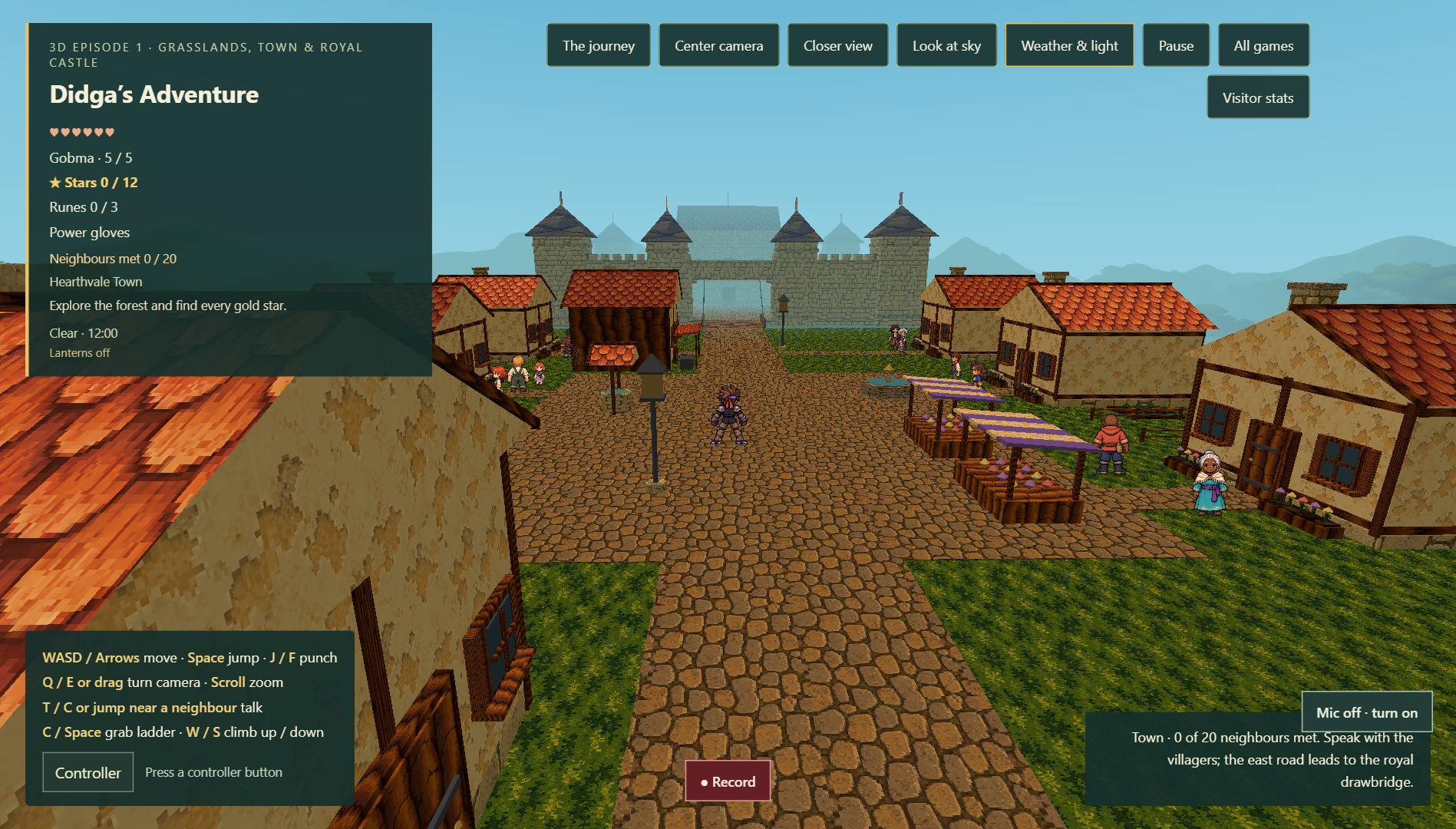
Version 0.25.0 expands the existing grassland with a town and the kingdom’s royal castle. Twenty villagers belong to eight households, with homes arranged around streets that lead toward a drawbridge over water.
Build the route before the decoration.
The map starts with three connected areas: the existing grassland, the town, and the royal castle. The forest stage and its underground cave keep their place in the adventure. The new road provides a continuous route into the town and onward to the bridge.
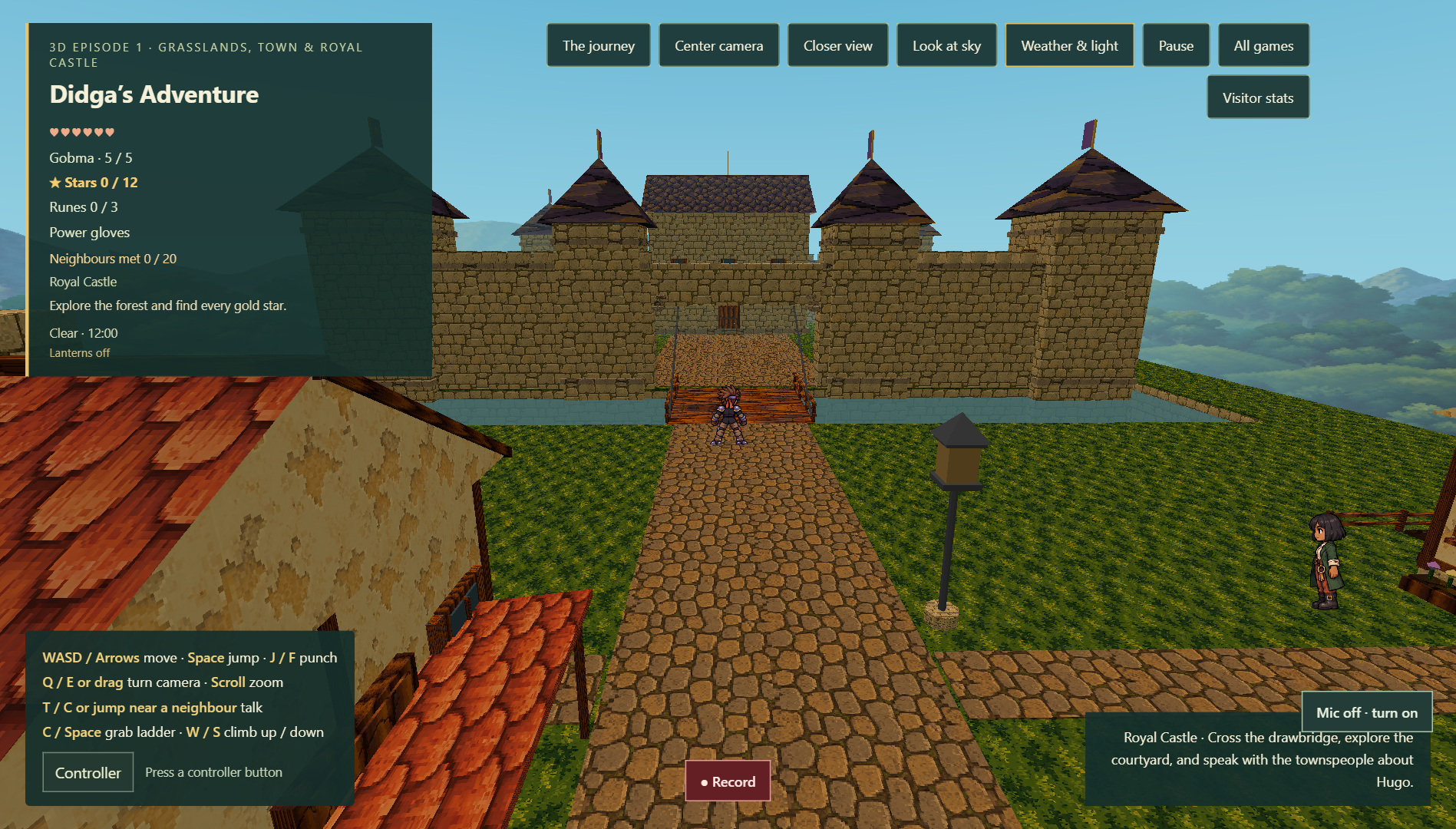
We lay out that route first, then place homes around it. Doorsteps face accessible streets, the square has room to turn the camera, and the bridge leads to the royal forecourt. A castle silhouette at the far end gives the player a landmark to navigate toward.
Plan households, then houses.
Twenty residents do not need twenty buildings. Four three-person households and four two-person households give the town eight homes. Each resident has an identity and a household, so the settlement can grow into a community rather than a row of empty facades.
This pass establishes the cast and their first conversations. Each resident has a name, role, home and dialogue. Talk introduces the people and Hugo’s threat; accepting, completing and rewarding their future tasks is still to come. House interiors are also future work.
Use real shapes and readable pixel textures.
The buildings, walls, roofs, bridge and moat belong to the 3D scene. Their simple forms keep corners and rooflines clear while the illustrated characters preserve the game’s hybrid style.
Image generation supplies an illustrated material atlas with four surfaces: roof tiles, plaster, stone and cobblestone. The game samples each material into a 128 × 128 texture and repeats it across the polygons. Existing grass and bark artwork supplies the lawns and timber. The original generated atlas stays intact in the project.
Nearest-neighbor sampling keeps the painted pixels crisp when enlarged. Texture coordinates follow the size of a surface, so a long castle wall repeats its masonry rather than stretching one small image across the entire wall. Shared materials connect the buildings, while gables, timber framing, chimneys, shutters and gardens distinguish their silhouettes.
The ground and building surfaces respond to the existing day, dusk and night lighting. This matters as much as the texture itself: a roof that looks warm at sunset should still belong to the same town at midnight.
Give flat villagers a direction in the world.
All twenty villagers use image-generated artwork, with four individually drawn directions per person: front, right, back and left. Four transparent image sheets hold eighty native views. The runtime selects a rectangle from the original sheet; it does not replace a person with a vector drawing or mirror one side to manufacture the other.
The renderer compares each resident’s heading with the camera position to select the appropriate drawing. Turning the view therefore reveals a front, side or back instead of keeping every face pointed toward the screen. Shared foot anchors and consistent height stop the selected views from jumping around on the ground.
Residents gently pace along short routes near their homes and turn toward Didga during conversation. These images are standing turnarounds, with a small movement bob; a full frame-by-frame walking cycle remains a later animation pass. Their color responds to day, dusk and night, and a contact shadow helps place each illustrated person beside a solid house.
Keep the atmosphere moving without crowding the frame.
The town uses the existing weather and daylight cycle. Windows brighten after dark, three local point lights cast warm pools onto the architecture, banners move and narrow highlights drift across the moat. Local lights switch off when the player is far away, and they do not add shadow maps.
Static architectural pieces are grouped by material within each building. That reduces separate rendering work while keeping the buildings useful as camera obstacles. The camera can pull in when a wall or roof gets between the player and the view.
Separate what is drawn from what blocks a path.
A wall needs both a visible surface and a physical boundary. A walkable street needs ground support. Those are different jobs: the camera can show a roof, but the player should collide with the house footprint, not an invisible box stretched across the entire neighborhood.
We check the continuous approach from the grassland, the streets between houses, and the crossing over the moat. The bridge must provide supported ground over the water while its sides keep the crossing readable. These route checks catch problems that a single attractive screenshot cannot show.
The moat is a real break in the ground, with visible water and a lower bed. Walking across the lowered bridge is supported; stepping into the moat does not secretly put the player on an invisible floor. Swimming and raising the drawbridge are not part of this pass.
Let the kingdom serve the story.
Didga is a traveler who comes across a town terrorized by Hugo and his band. Hugo wants control over the land and holds the princess in a fortress he has built for himself.
The castle beside this town belongs to the kingdom. Hugo’s fortress comes later. The planned campaign leads through five guarded gates, with jewels earned through puzzles and encounters with their protectors. The first planned jewel route goes into the underground maze beneath the current grassland and opens a blocked path above.
The town is the foundation for that story. This release does not yet add Hugo, five playable jewel challenges, the finished underground maze or the princess rescue.
What was checked.
All 459 game checks and 13 website-package checks passed. Native browser checks confirmed the normal spawn-to-town, drawbridge and royal-courtyard route using actual movement controls with zero respawns; Finn’s conversation, the unique neighbours-met counter and movement/time pausing during dialogue; directional villagers as the camera turns and the town’s day/night material, window and lamp changes; local PNG downloads of the town square and royal approach from the public game package.
Software checks and browser traversal are separate from physical-controller testing. This first town release does not establish a completed campaign, solved underground maze, rescued princess or finished villager quest system.
Near a resident, use the Talk button, T or C on the keyboard, or the controller’s mapped jump action. A conversation pauses movement and the world clock. Closing it requires a fresh button press, so the press that starts a conversation does not immediately close it again. These software input checks do not establish a new physical-controller hardware test.
The public package keeps player controls, local recording and Screenshot PNG. Creation tools remain in the offline project; this article documents how the world is made without adding editing tools to the public game.