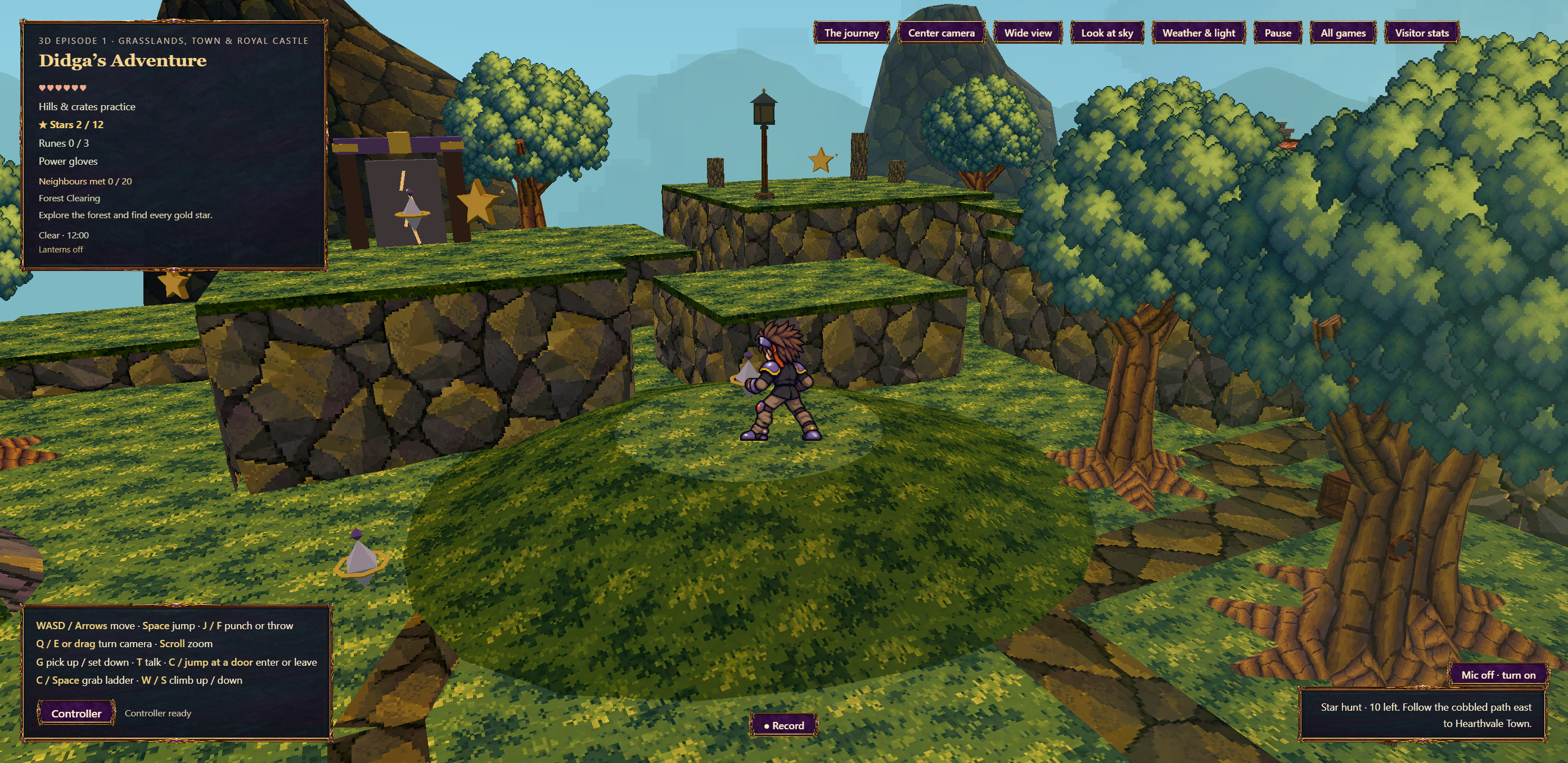
The request began with the opening blocks: keep the jumping, but turn a couple of the terraces into hills that can be climbed and slid down. Then add real 3D boxes that Didga can pick up and throw. Version 0.27.0 brings those two ideas into the existing forest.
The ready screen now offers Try hills & crates. This peaceful practice start places Didga beside a wooden crate near the opening hills, with Gobma’s encounter held back for the session. It gives the player room to learn carrying, throwing, climbing and sliding. Enter the forest retains the regular adventure start and its Gobma fight.
Super Mario 64 was the requested movement reference. The goal here is a playful sense of weight and a readable slope response. Didga’s acceleration, gravity and steering are tuned for this forest stage.
Two hills with different jobs.
The eastern terrace becomes a broad meadow hill with a gentle approach and a flat summit. Its rune and star stay at their original coordinates. The western terrace becomes a smaller hill with a longer southern approach and a steeper face for testing a slide. Its star also stays on the summit.
Each outline uses twenty-four directions and four curved contour bands. The heights blend from the forest floor to the top, rather than hiding the old box beneath a decorative slope. Existing native grass and stone artwork wraps the actual surface with nearest-neighbor filtering, keeping the painted pixel texture consistent with the forest. Exposed stone belongs to the steep faces themselves.
Flat trail artwork is trimmed at each hill’s footprint. It stops at the rising ground instead of floating across a slope. The remaining jumping tiers, cave opening and road into Hearthvale keep their places.
Let gravity do some of the work.
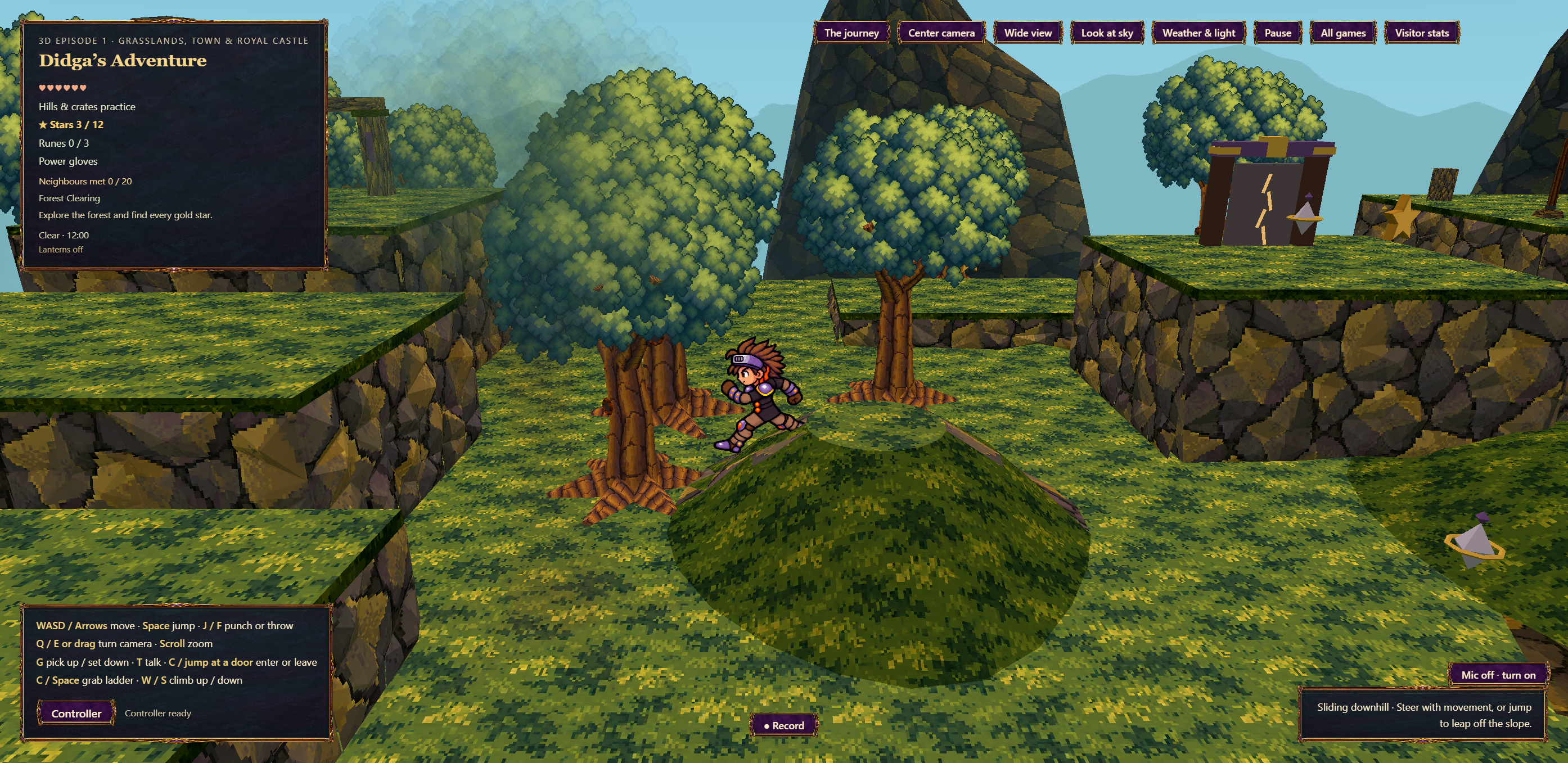
The controller reads the ground’s height and normal beneath Didga’s feet. Running uphill works against gravity; downhill movement gains speed. On a sufficiently steep face, gravity pulls Didga into a slide while directional input still lets the player steer.
Momentum carries through the transition between slope and flat ground, then friction settles the movement. A jump leaves the supporting surface and follows the existing airborne collision rules. Gentle ground remains comfortable to climb, while the western face makes the downhill response easy to test.
Give the gloves something to carry.
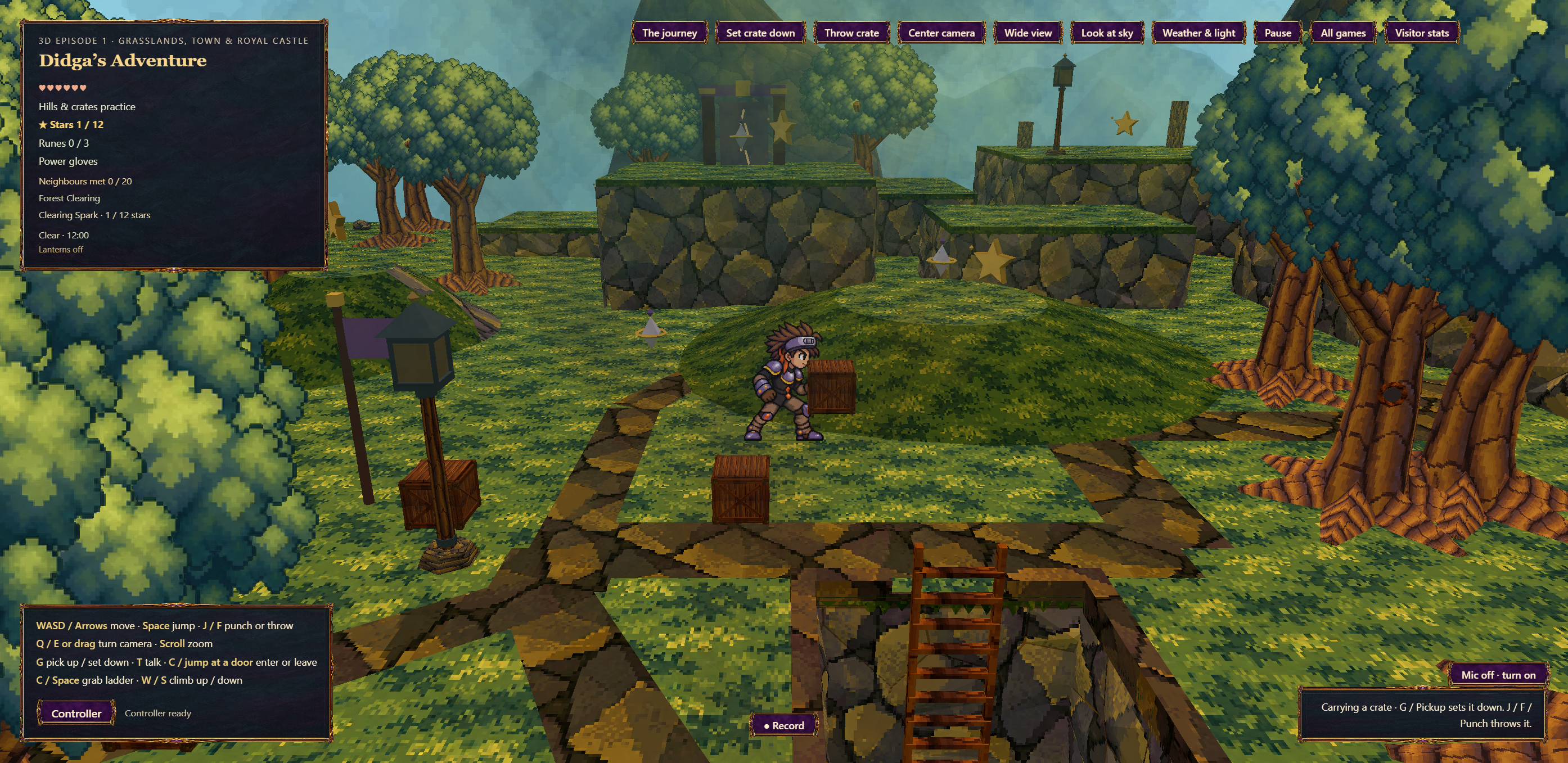
Wooden crates are solid 3D objects with native painted timber and brass textures. They rest on real ground, react to gravity and collide with the stage. Didga can approach a crate, pick it up, carry it and release it as a throw or a drop.
The pickup action is separate from jumping and punching. The keyboard uses G; the default controller mapping uses the top face button, and the action can be remapped in Controller settings. The in-game prompts explain the available action while approaching or holding a crate.
The camera ignores a held crate when resolving its orbit; loose crates continue to obstruct the camera.
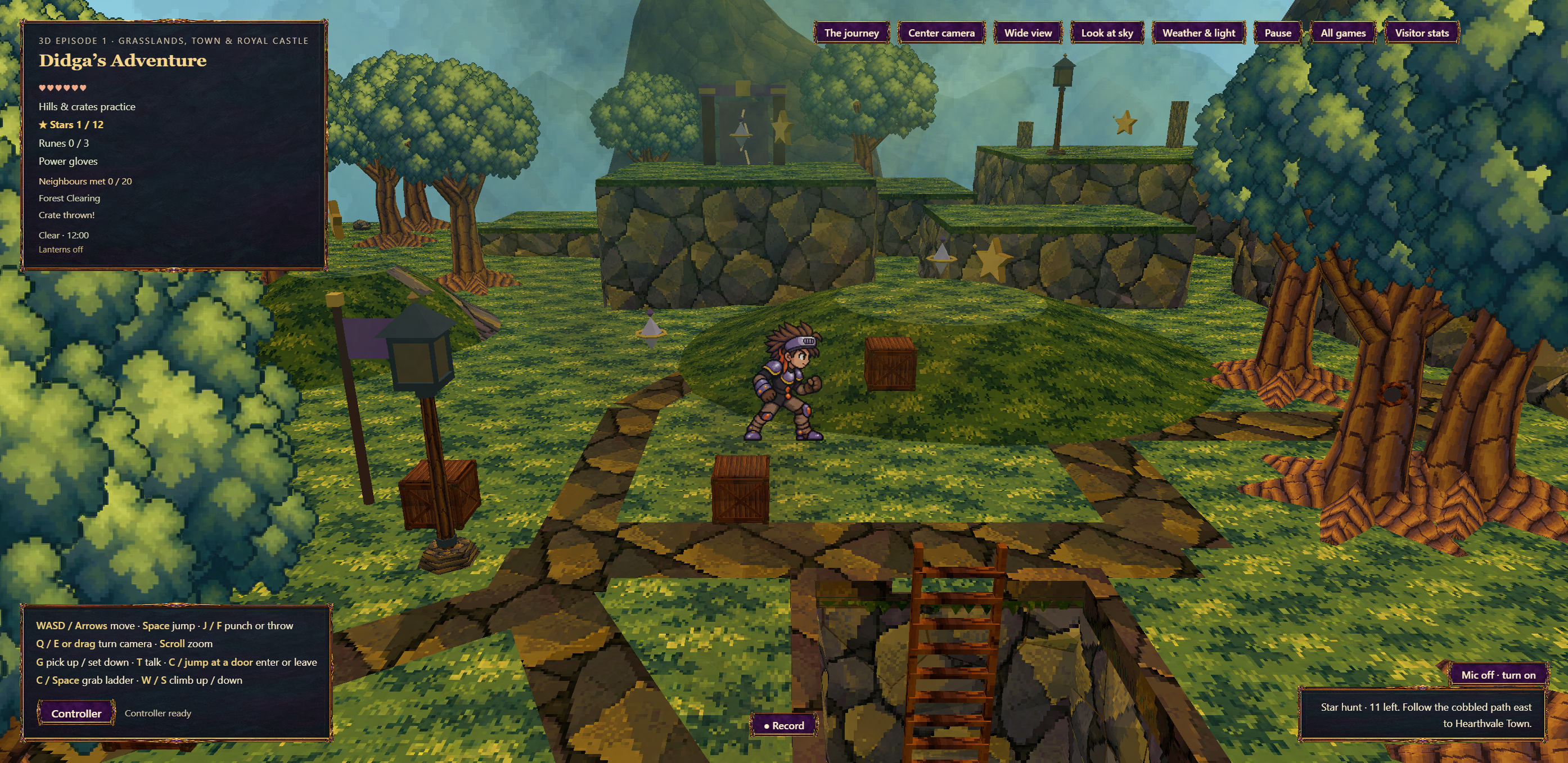
A released crate returns to physical simulation. Its trajectory and the surface beneath it decide where it lands. A drop is useful for placing it nearby; a throw gives the same object more momentum. The crates are a first interaction test, with room for later puzzles and more uses for the power gloves.
Use one ground surface for drawing and contact.
The visible hill mesh and the physical sampler share the same authored vertices and triangles. A ground contact uses barycentric interpolation inside the exact triangle under the actor. Its normal supplies the slope direction, so the character’s feet and the painted surface describe the same place.
Gobma’s pursuit and combat pushes use that terrain support too. An impact follows the rising ground while retaining the real walls, overhead clearance and stage edges. The encounter therefore shares the slope that Didga is standing on.
Automated raycasts check every hill face against that sampler, including its height and normal. The climb check drives Didga up the complete eastern approach with ordinary movement and compares his supported feet to the rendered terrain. Resource checks also confirm that the new meshes release their own geometry, material and texture copies once while preserving the shared source artwork.
Keep the adventure connected.
The twelve original stars and three runes have not moved. The acceptance route launches toward the northern ridge from the eastern summit and aims inside the western summit after its final jump. Those are walked and jumped routes through the new shapes, with the existing trees, ruins and stage collisions still active.
Root Hollow Cave, the town, family homes, royal hall, water, weather and character conversations remain part of the same world. Screenshot PNG and the recorder still save locally, with an optional microphone. Creation tools remain in the offline project.
What the checks prove.
All 603 game checks, 90 website-package and release-tool checks, and 13 offline publisher checks passed. Native browser checks confirmed the peaceful practice start beside a crate, with the regular forest and Hearthvale starts still available; using G to set a crate on the ground, pick it up again and carry it while walking; using J to throw the crate, observing it airborne and then grounded at rest; walking to the eastern hill’s 1.5-unit summit without jumping or respawning; climbing the western approach to its 2-unit summit, steering onto the steep face and sliding back to stable forest ground without a respawn; pause holding the player and carried crate at the same positions; the visible remappable Pickup action in Controller settings; four saved gameplay PNGs showing the hills, slide, carried crate and thrown crate.
The automated acceptance route reaches all twelve original stars using ordinary movement, gravity, collision and seventeen jump presses, without warping or respawning. A second route collects all three runes, earns the Breaker gloves, opens the seal and crosses the exit using the real hill terrain.
Browser checks describe the reviewed build. Controller mapping is software coverage; it does not establish a fresh test of a physical controller.