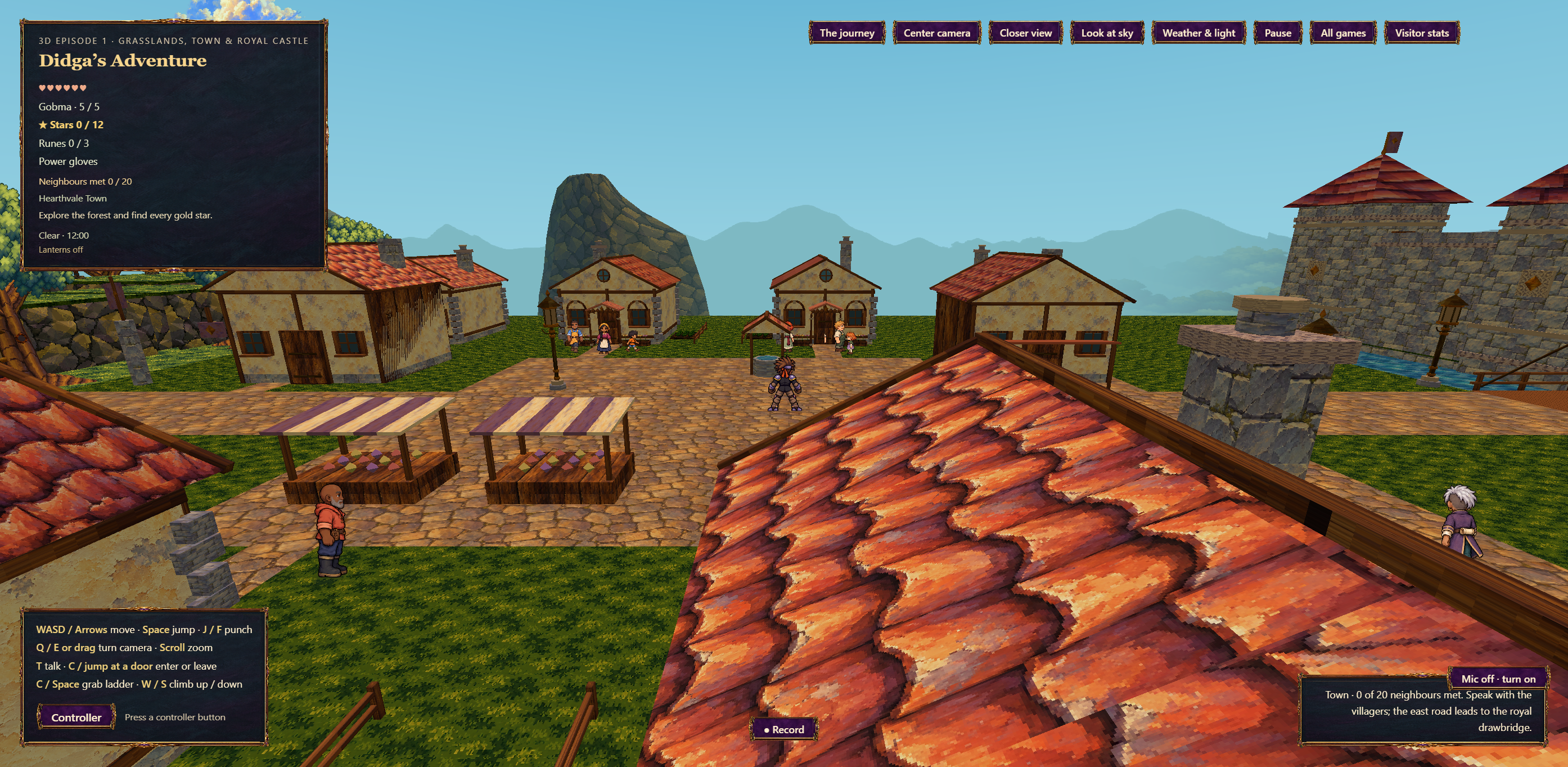
The first Hearthvale pass connected the grassland, eight households and the kingdom’s castle. Version 0.26.0 develops what happens inside that layout: richer materials, carved architecture, family rooms, walking residents and a daily rhythm.
The ready screen offers Explore Hearthvale to begin in the town square for a quick visit. Enter the forest starts at the original grassland approach, with the road into town ready to follow.
Paint the surface. Shape the silhouette.
The request was clear: the town should feel illustrated, including its 3D buildings. A texture has to carry brushwork and color variation, while the model needs a shape that gives those marks a purpose.
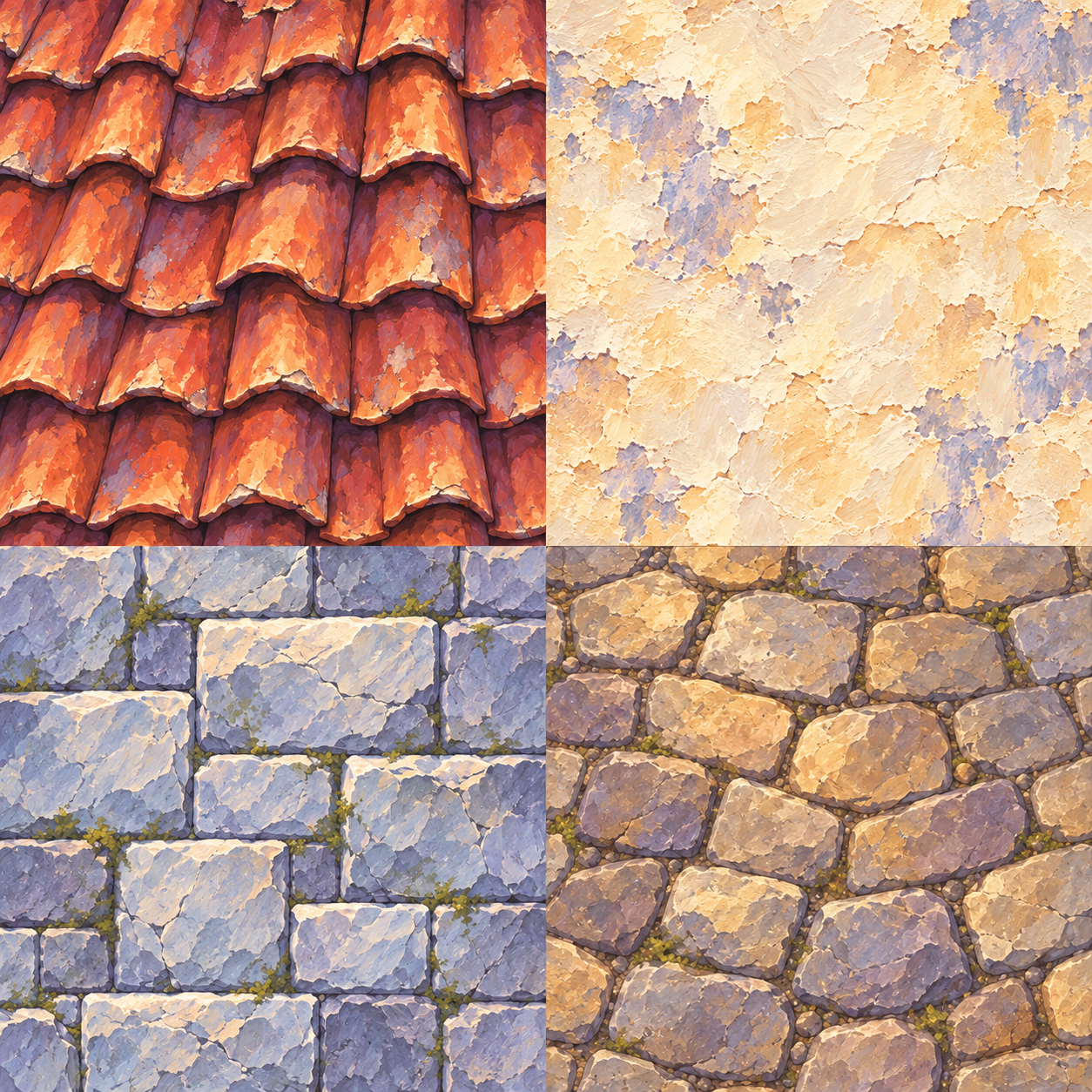
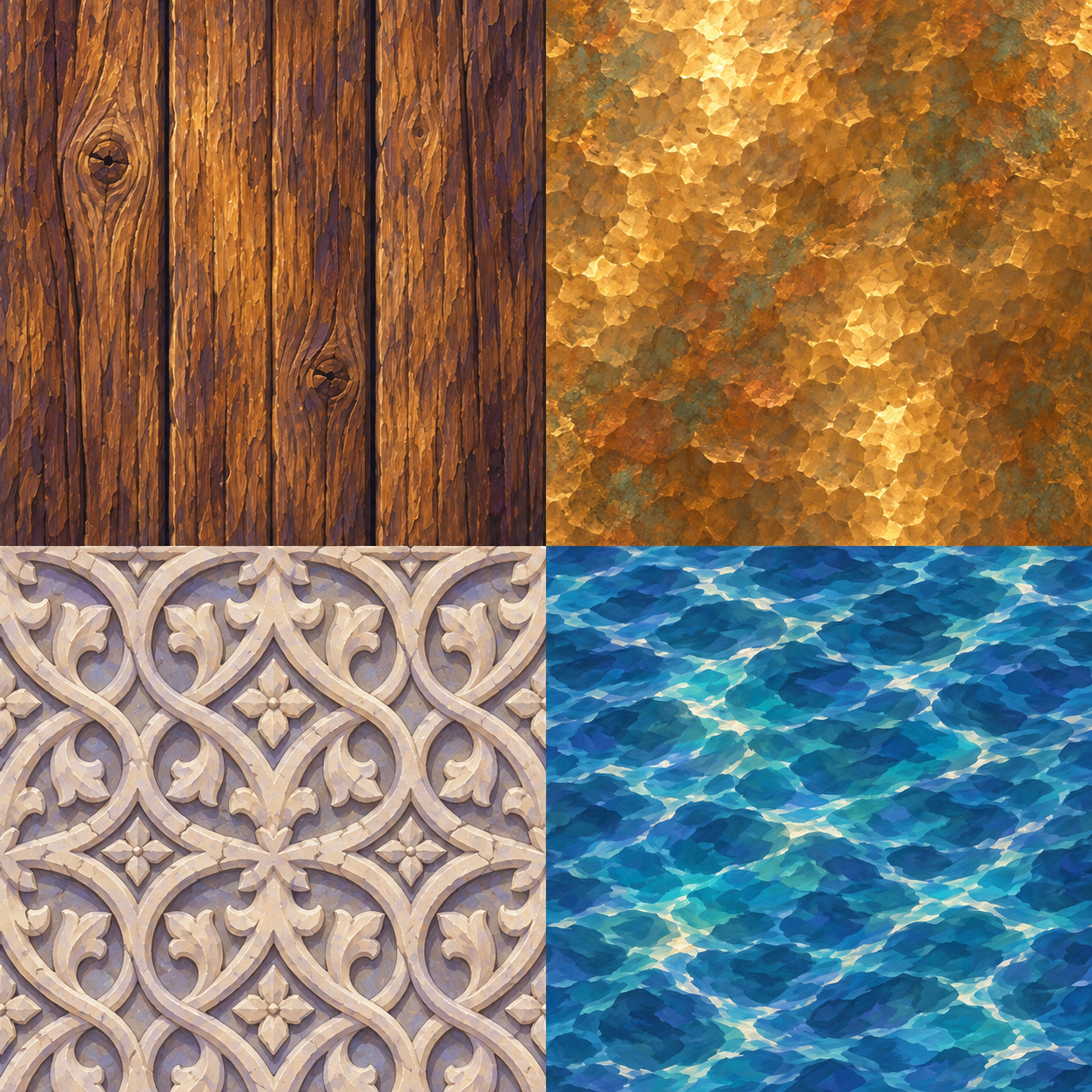
Two new native material atlases supply eight surfaces: roof tile, plaster, masonry, paving, timber, brass, carved stone and water. Small runtime samples repeat across the architecture. Nearest-neighbor enlargement preserves the older console feel, while mipmapped minification keeps distant roofs and paving from crawling as the camera moves.
House detail now extends beyond a painted box. Scalloped roof edges, deep eaves, arched window hoods, turned porch posts, stone corner blocks and varied chimneys break up the outline. Castle pilasters, carved friezes, banners and a layered entrance arch build a stronger royal landmark.
Give the street room to move.
More decoration cannot come at the cost of a clear route. The main road, square and household frontages still leave room to walk, turn the camera and approach a neighbor. The new paving is cut into a single visible surface at each point, removing overlapping road and porch planes that could flicker against each other.
Five ornate lamp posts replace the earlier simpler fixtures. Their brass stems, brackets and warm glass remain visible details by day; after dark, a small pool of nearby 3D lights illuminates the street and characters. Distant lamps retain their glow without adding a separate active light for every building.
Flower stems and petals move with the wind. The moat receives painted water, small surface waves and drifting highlights. The portcullis rises vertically as Didga approaches and lowers when he leaves; its physical boundary moves with the visible ironwork.
Twenty residents need real walking poses.
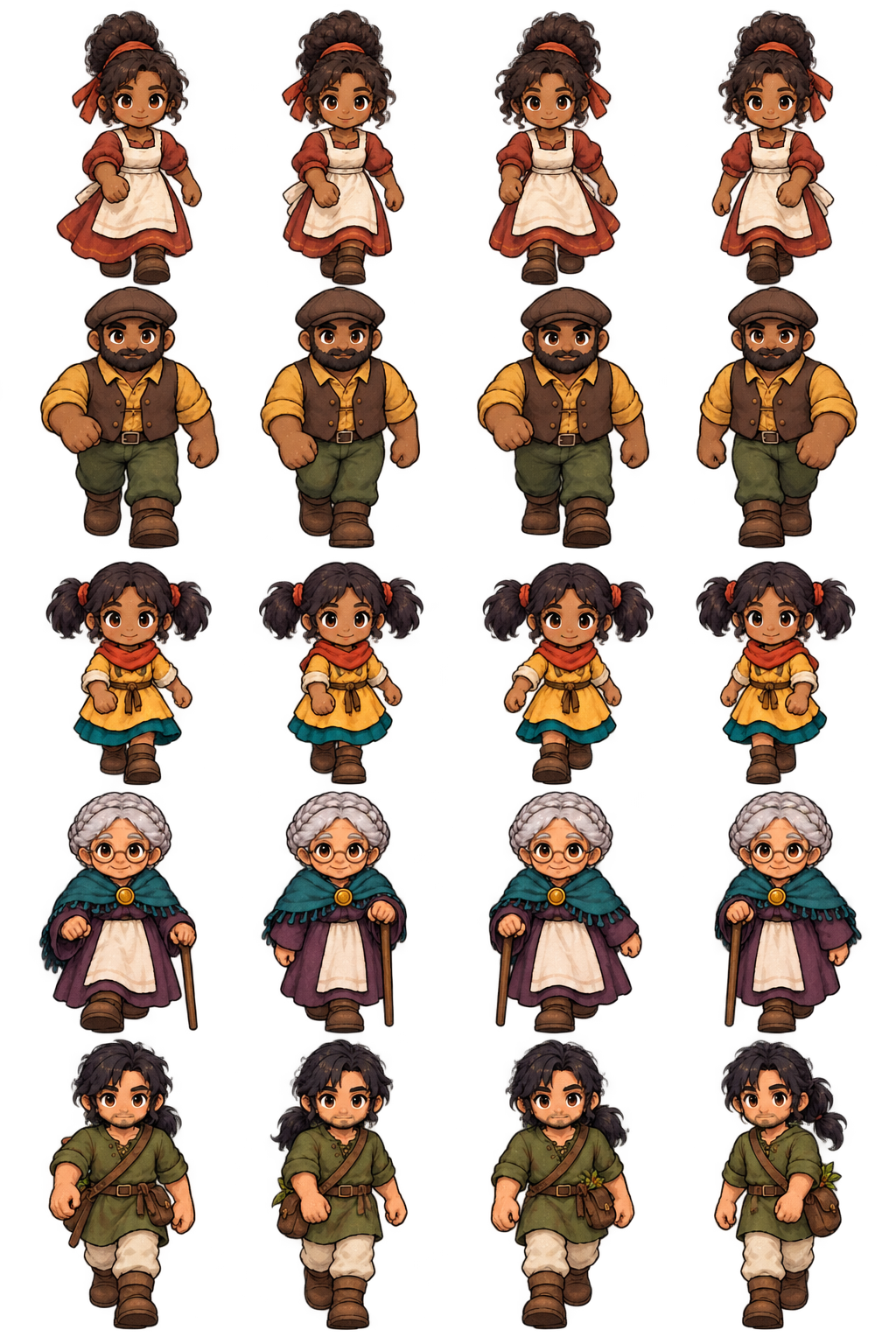
The previous residents used standing directional drawings while pacing near home. This pass replaces that movement with 320 authored walk frames: twenty people, four directions and four gait poses in each direction.
The passing poses redraw the arms and legs between contacts. A bob or a sliding standing image cannot supply that change of weight. The renderer chooses a view from the resident’s heading relative to the camera, advances the gait with distance traveled, and returns to the original idle artwork when the person stops.
Didga receives a related gait pass: five authored view families with four running poses each. The goal is a consistent character as he moves from the front into a diagonal or a side view, with the arms participating in the run.
A home beyond every family door.
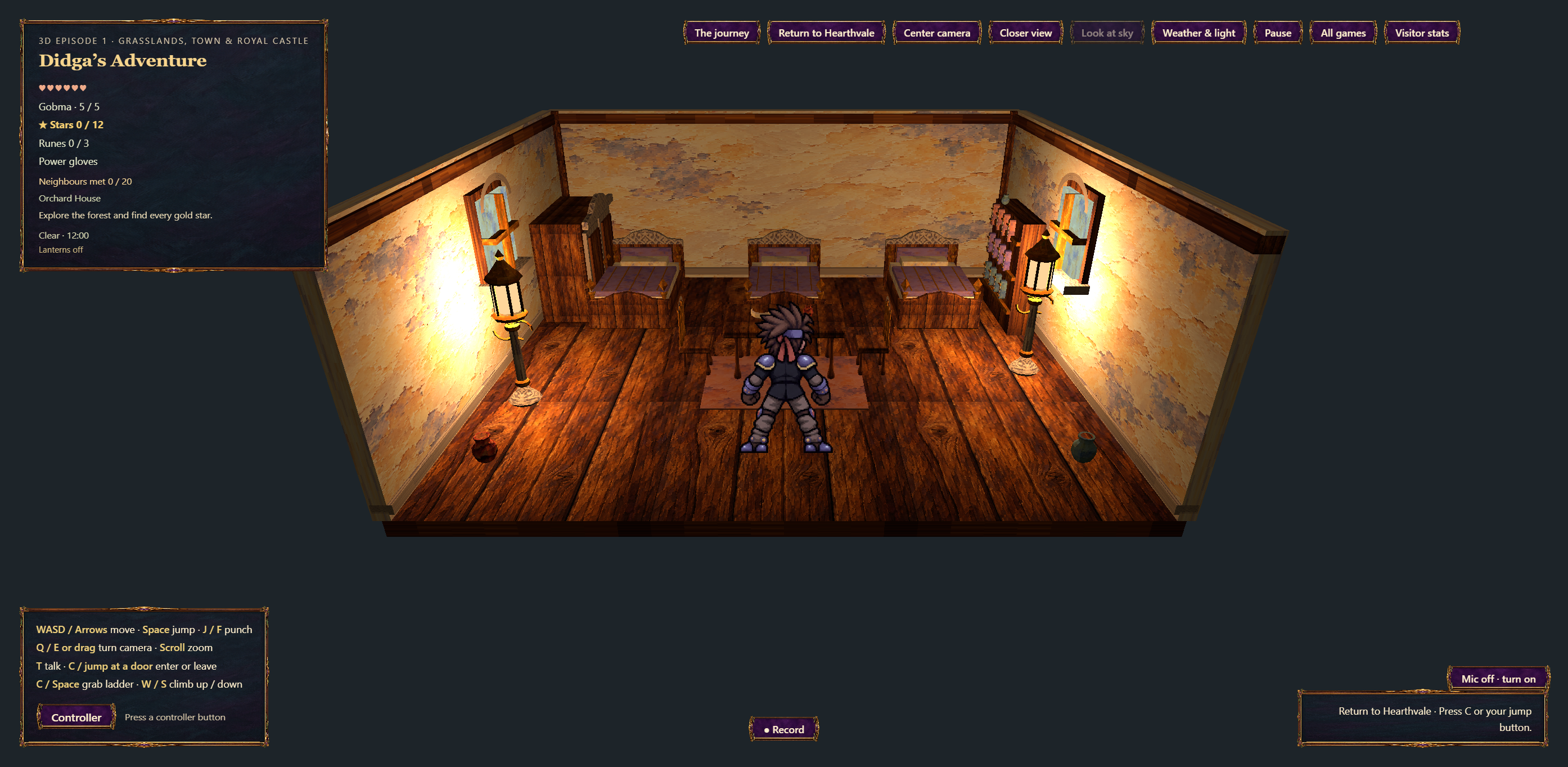
The eight households keep their original capacities: four homes for three people and four for two. Each home now opens into a furnished room, with one bed for every resident. The twenty beds have reachable fronts and clear household aisles.
Turned brass bedposts, acorn finials, scalloped headboards, quilt seams, carved cupboards, books and pottery give the furniture a silhouette of its own. The room lamps stand on the floor and light the painted walls. Door and window trim belongs to the wall that carries it, so a camera cutaway hides the whole section together.
Let the clock change where people belong.
Residents follow individual daytime visits and evening returns. They approach their own porch, enter their room and reach their assigned bed. The route aligns with the public frontage before turning toward the door, keeping residents out of planters and porch posts.
Eighteen residents follow regular evening schedules. Corin stays out later and returns before two; Vale keeps the night watch. An automated run with the real town and room collisions brings nineteen residents into their beds by 01:57, while Vale remains outside.
Morning reverses the trip: wake, leave the bed through the room aisle, pass the door and return to the neighborhood. A short daytime visit ends from the resident’s actual position rather than moving them to a bed first. A resident waits if Didga is blocking the doorway, then continues when the route clears.
A conversation has two sides.
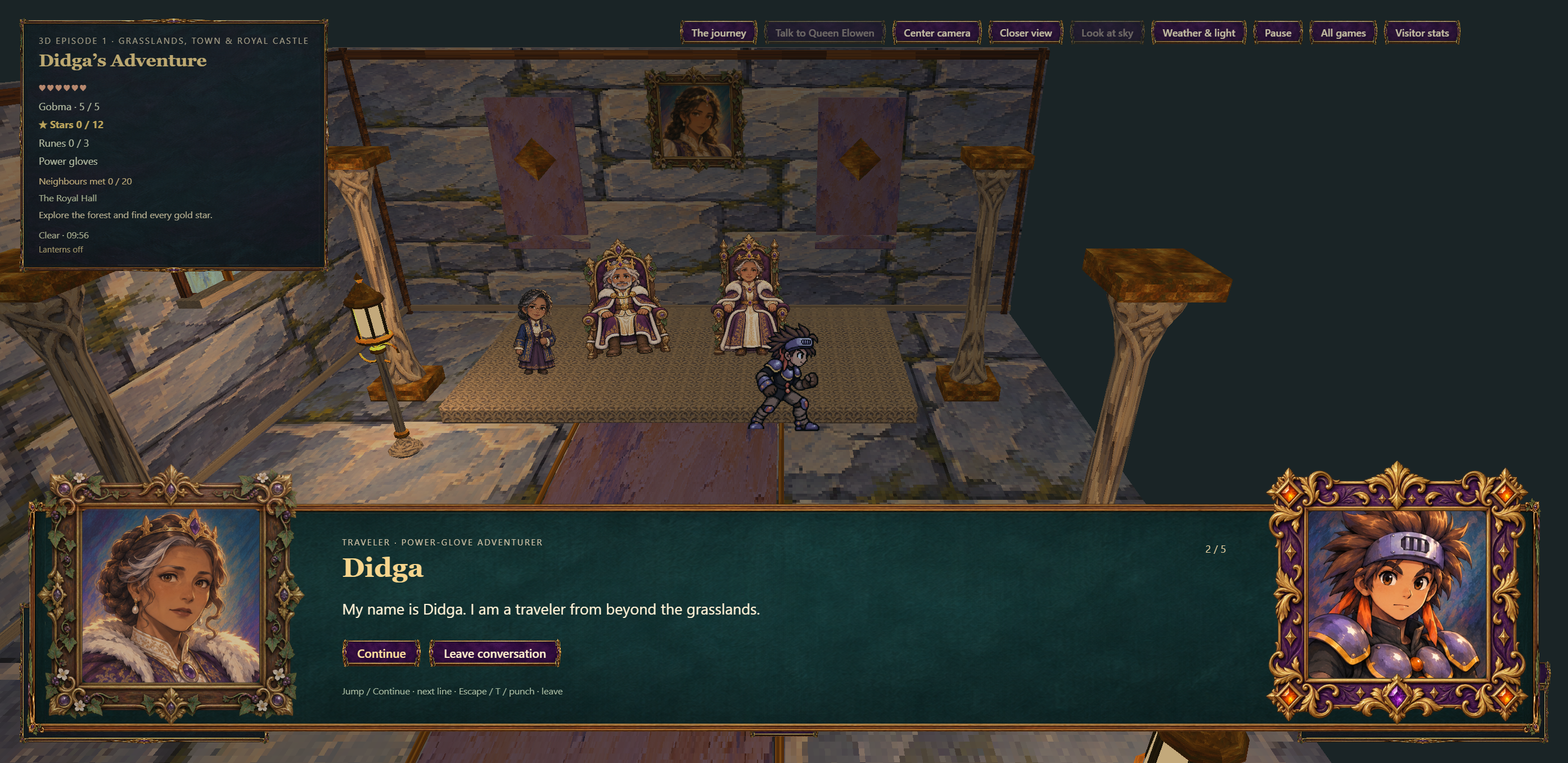
The dialogue pass pairs a native character portrait with an illustrated frame and gives Didga his own replies. The portrait bank is organized around twenty-six identities and ten expressions per identity, including Queen Elowen, so a conversation can carry concern, determination or a lighter moment without replacing the character’s design.
Portraits select rectangles from original image sheets. A separate native frame sits over the portrait opening, keeping the illustration inside its border. The world and its routines pause during the exchange, and button presses advance a conversation one beat at a time.
The conversation now stretches across the bottom of the game view. Large framed portraits give both speakers room beside the text, with a stacked arrangement on small screens. Original painted bitmap panels and button plates carry the same carved wood, antique gold and purple details into the game menus, weather controls, controller settings and recorder. Their corners retain the original artwork as each panel stretches to fit its contents.
Make the royal hall worth entering.
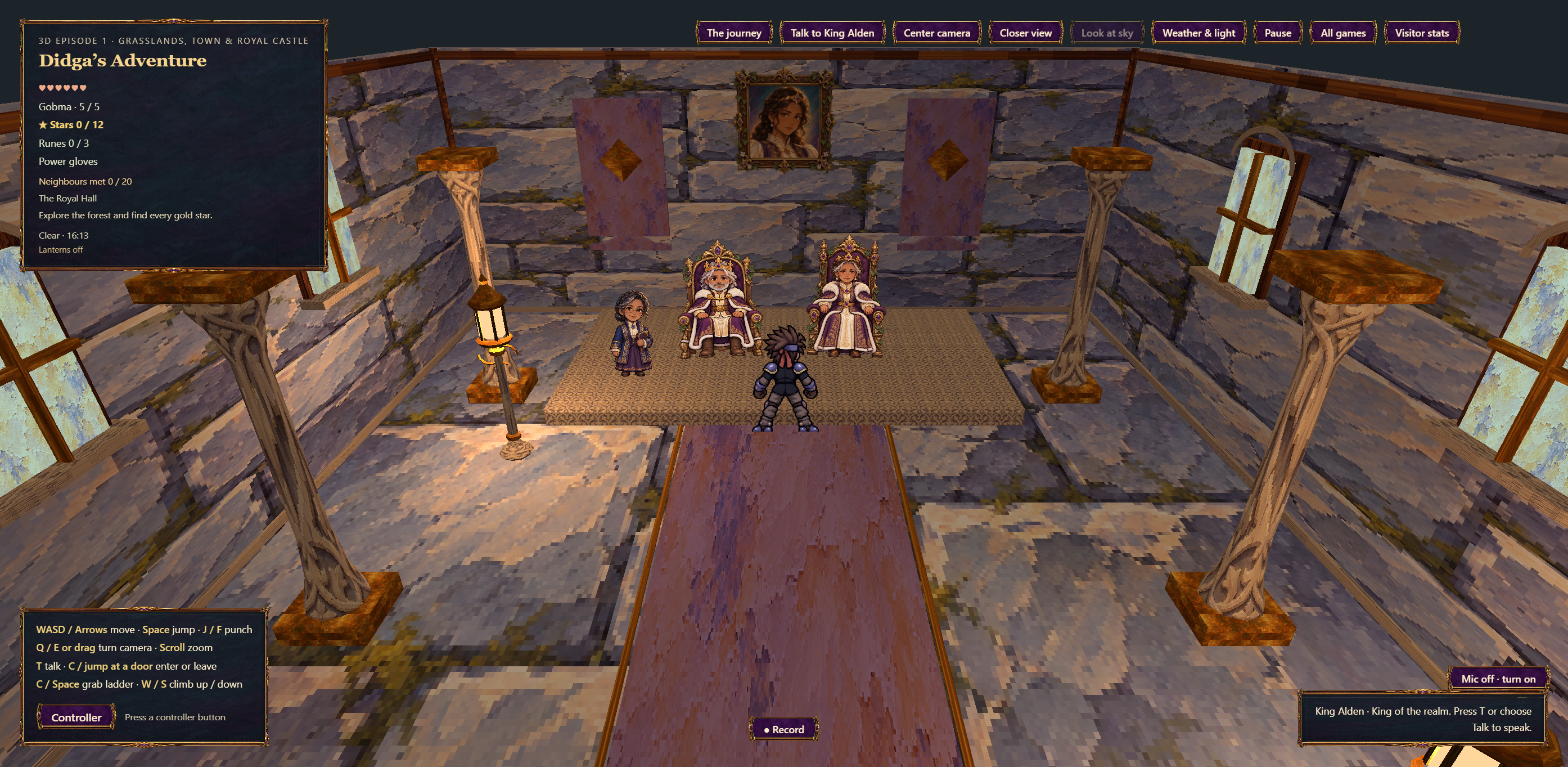
The kingdom’s castle continues inside. A carpeted aisle leads through the hall toward the royal dais, with fluted columns, ceiling arches, a chandelier and two illustrated thrones with carved panels, gilded scrolls and crowned backs.
King Alden, Queen Elowen and Advisor Miren give the kingdom a voice. The royal guard uses one authored knight design for six guards, with directional walking artwork. Their conversations explain the kingdom’s situation without pretending that the whole campaign is already playable.
The king and queen each sit in an illustrated throne. Their seated bodies and chairs are drawn together for four viewing directions, replacing the separate 3D chair that could intersect the king’s artwork. The complete images stay upright as the camera tilts, with their chair legs anchored to the dais. Separate collision footprints keep Didga from walking through the painted chairs while leaving the aisle clear. Each royal has a separate position, portrait expressions and conversation.
Water needs a way back out.
The moat is a real gap in the ground. The swimming controller gives Didga buoyancy, keeps his head above the surface, and lets a jump carry him back onto a bank. Castle walls and bridge supports still have physical boundaries; entering the water does not remove them.
Drawn swimming poses follow the camera-relative direction, giving the paddling its own animation rather than reusing a run in the water.
The water rules are optional for the old movement system. Outside a water volume, ordinary movement, jumping, climbing and falling keep their behavior. Swimming animation and its native browser check belong to the same review as the water movement.
What the checks prove.
All 530 game checks, 35 website-package and release-tool checks, and 11 offline publisher checks passed. Native browser checks confirmed entering a furnished household from the town and arriving at its clear interior doorway; Mara’s conversation, Didga’s reply and the world pausing during their exchange; entering the moat, selecting right and rear swimming drawings as the camera turned, paddling to the bank and jumping out with zero respawns; the portcullis rising during the approach and four royal knights visible in the courtyard; reaching King Alden from the carpet, seeing the king, advisor and princess’s family painting, and advancing from the king’s framed portrait to Didga’s reply; large paired portraits and the long bottom dialogue panel in a saved gameplay PNG; native painted ready, weather, controller and recorder panels, including the controller dialog remaining clickable after scrolling the page; all ten Queen Elowen expressions in the offline portrait gallery; the final public package’s king and queen seated in complete painted thrones from front, rear and both profile camera angles, with their chair feet on the dais; approaching Queen Elowen from the carpet, opening her conversation and advancing to Didga’s reply with the large framed portraits visible.
The software checks cover supported movement, collisions, household routes and the advancing day/night schedule. Browser checks demonstrate the reviewed build; a new physical-controller hardware test is a separate result.
The household acceptance checks use ordinary movement against the actual support and collision data: entry to exit, all twenty bed fronts, the royal aisle and the king’s conversation spot. Daily-routine checks advance the clock through evening and morning, test a blocked doorway and confirm that a paused world freezes the routes.
These additions grow the town. They do not complete Hugo’s fortress, the underground maze, the five jewel challenges, villager task rewards or the princess rescue. Princess Liora’s character artwork supports that story while her captivity remains part of the journey ahead.
The public game keeps player controls, Screenshot PNG and local recording with an optional microphone. Its creation tools stay in the offline project, and recordings remain local downloads.