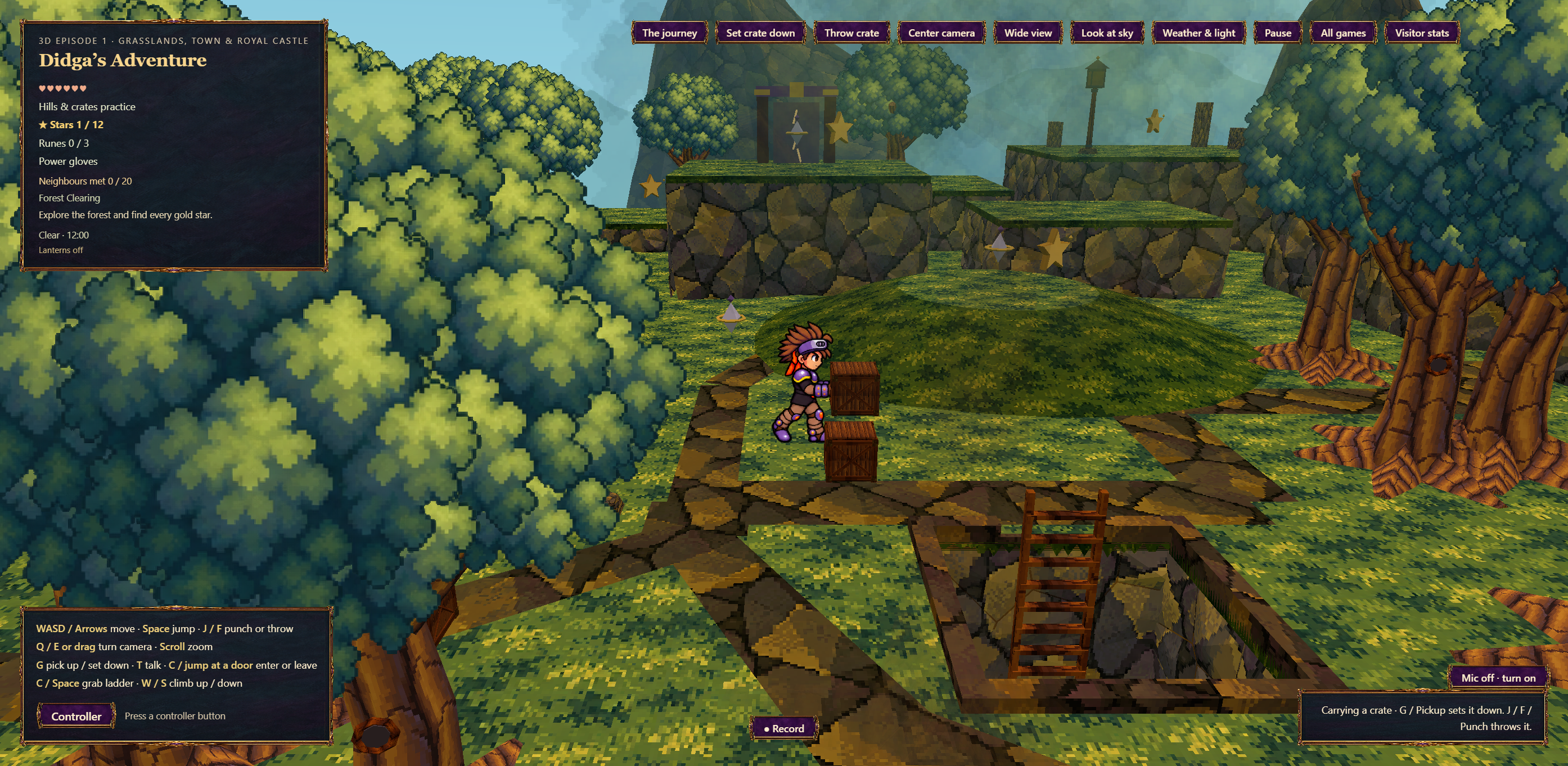
The first crate test established picking up, carrying, dropping and throwing a real 3D object. The next request is about the hero: give him a proper carry animation and a throw animation, so the action is readable in his shoulders, hands and feet.
Version 0.28.0 builds on the hills-and-crates test. The peaceful Try hills & crates entry remains the practice space. Enter the forest keeps the regular adventure, and Explore Hearthvale starts in town. The forest, cave and kingdom stay connected.
Draw the action from more than one side.
The art uses five native directional sheets: front, front-right, right, back-right and back. Opposite views use the matching mirrored direction. Each sheet has ten distinct poses: four carrying-walk frames and six throw frames. The carrying walk includes feet together between the open-leg steps, keeping the transition visible instead of snapping between two extremes.
The illustrated raster sprites keep the existing pixel sampling. Each view uses a fixed horizontal foot anchor and one pixel scale, with the drawn foot height measured for every pose. This keeps a raised arm from shifting the whole character sideways. The original five PNG files and all fifty drawings are preserved exactly. The export also retains all 104 previously approved native game images.
Carry the same physical object.
The wooden crate remains a separate, textured 3D object. The character sheets contain the hero’s pose without a second painted crate. The held object follows a hand anchor through the carrying stance and throwing motion, then leaves the hands at the physical release.
The carrying cycle follows distance travelled: four drawings over 3.2 world units, equivalent to eight frames per second at full running speed. Stopping holds an idle grip. Action priorities preserve hurt, climbing and swimming poses, while the presenter only selects artwork. The physical action module controls when the crate is released.
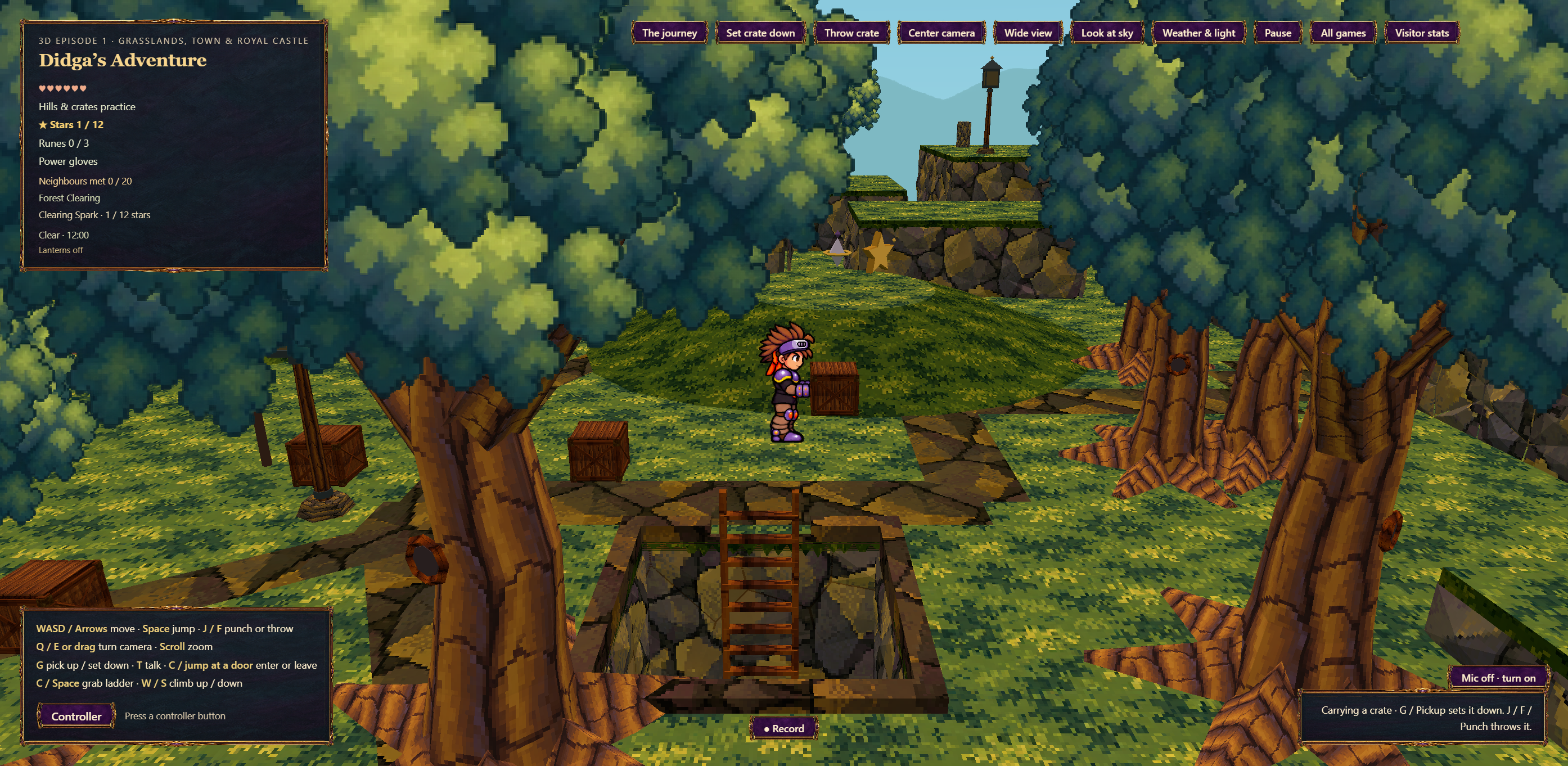
Give the throw a moment to happen.
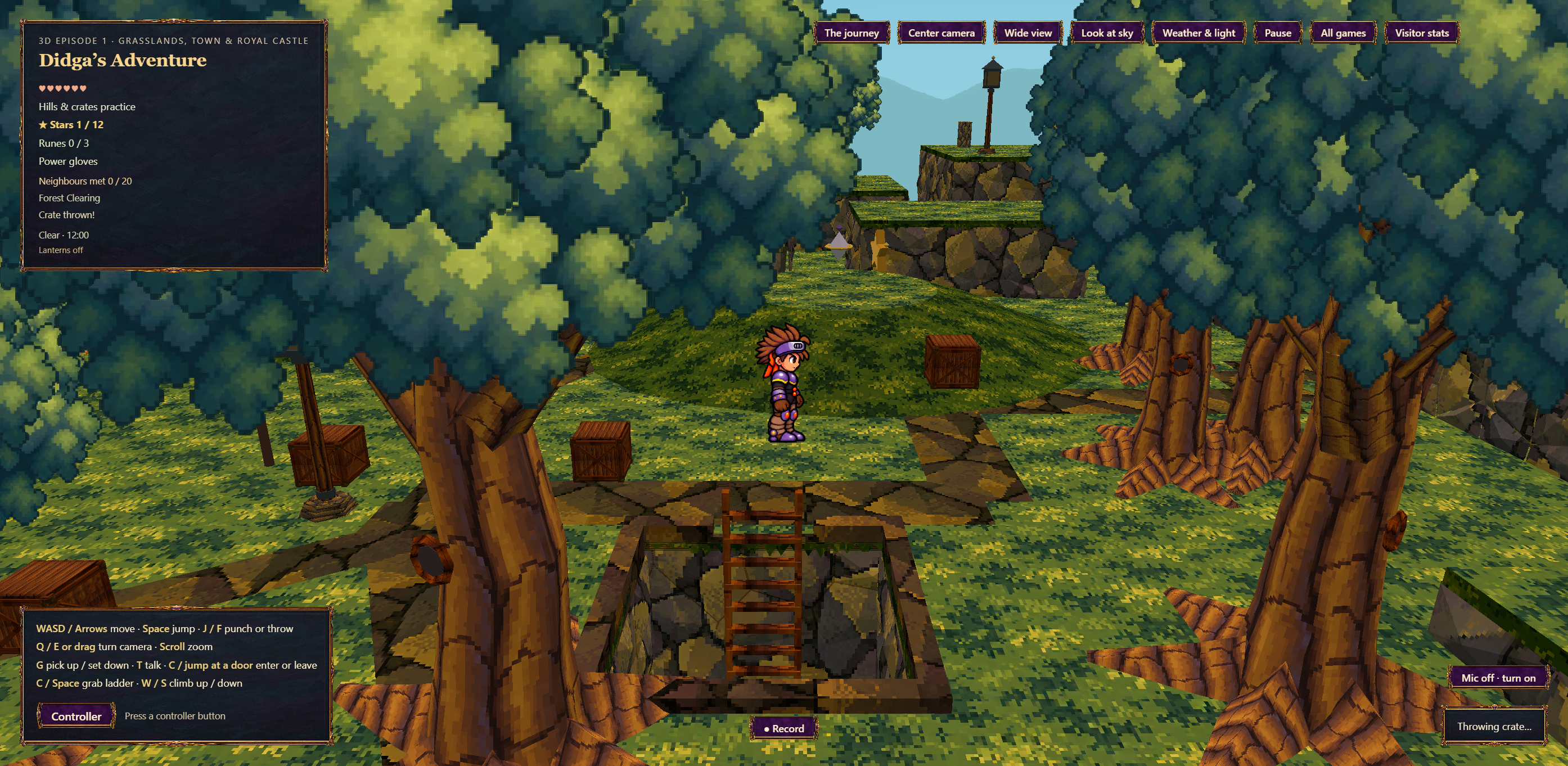
The six-pose throw has a short preparation, a release and a recovery. Native key input and read-only scene diagnostics showed the crate still held at 0.067 and 0.133 seconds, released at the fourth pose after 0.20 seconds, then recovered after 0.50 seconds. A pause during the preparation froze the pose and crate; another throw press during that pause left them unchanged. Continuing resumed the original throw once.
Once released, the same crate resumes gravity, stage contact and its existing momentum. The keyboard pickup and set-down action remains G; a held crate uses J or F to throw. Controller Pickup remains remappable, with the top face button as its default.
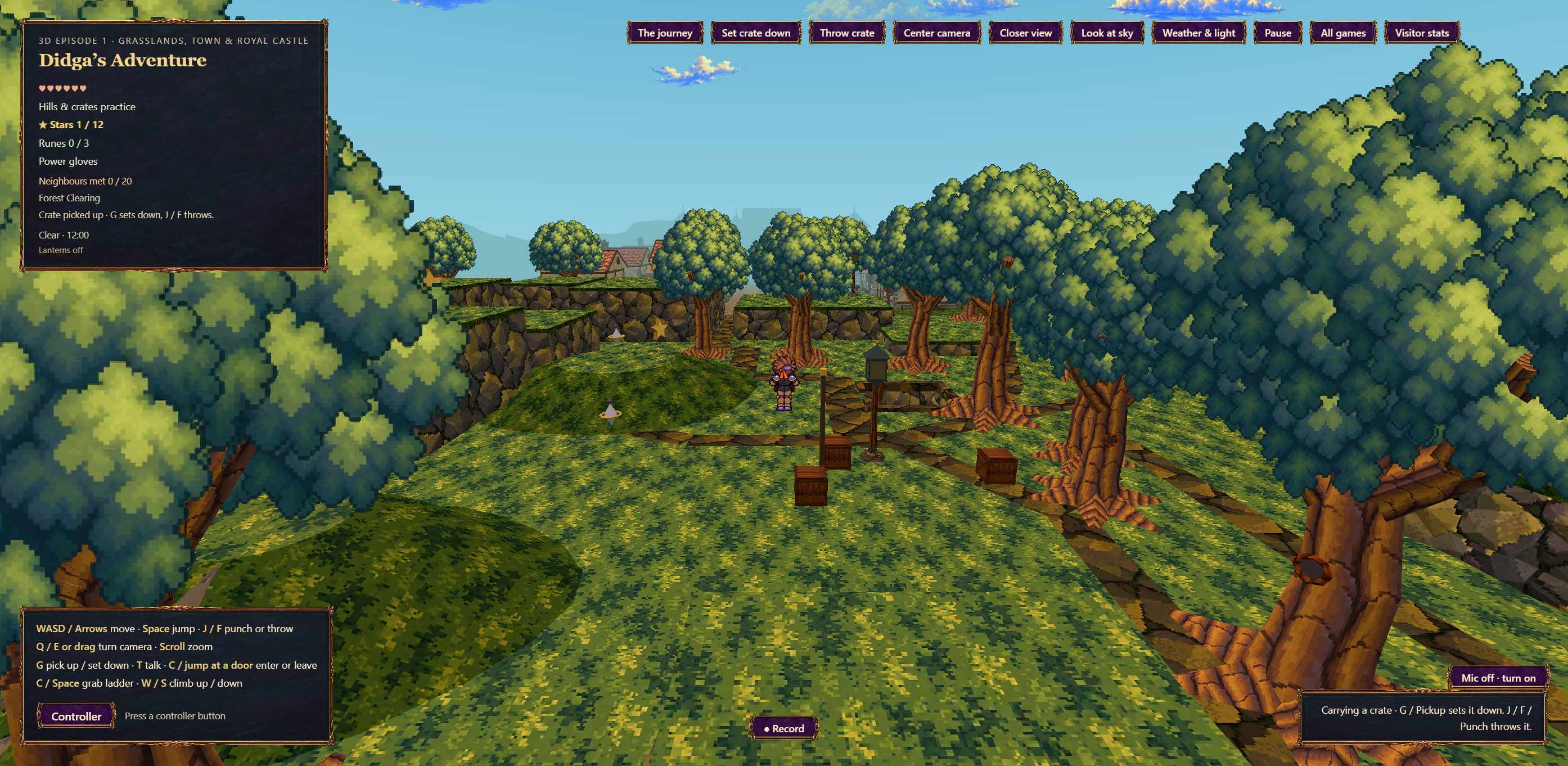
Keep the view readable.
The orbit camera continues to ignore the currently held crate while keeping loose crates, walls and hills as obstacles. Native carrying checks kept the close camera at 18 units and the wide camera at 25 units across front, side and back views. The held object no longer forces the camera into Didga.
What the checks prove.
All 629 game checks, 104 website-package and release-tool checks, and 15 offline publisher checks passed. Native browser checks confirmed the passing and release drawings in all eight gallery directions, with front, side and back carrying views in the game; open-leg carrying steps, stable hands around the separate crate and an idle grip when stopped; real throw input retaining the held crate during the windup, releasing it at 0.20 seconds and recovering after 0.50 seconds; pause freezing the action clock, pose and crate while ignoring another throw press, then resuming one throw; close and wide camera views remaining at their requested distances while carrying; a fresh ordinary punch after the carry throw had recovered; the public recorder and PNG controls, with no captured browser errors.
The four PNGs show a carrying step, the grip before throwing, crate flight after release and a wide camera view. Exact throw timing comes from real key input and read-only scene diagnostics; the still images do not establish a particular throw frame.
Drop, blocked release, respawn, climbing and swimming interruptions have automated integration coverage. The native review does not claim a walkthrough of every interruption. Software controller mapping checks do not establish a fresh test with a physical controller.