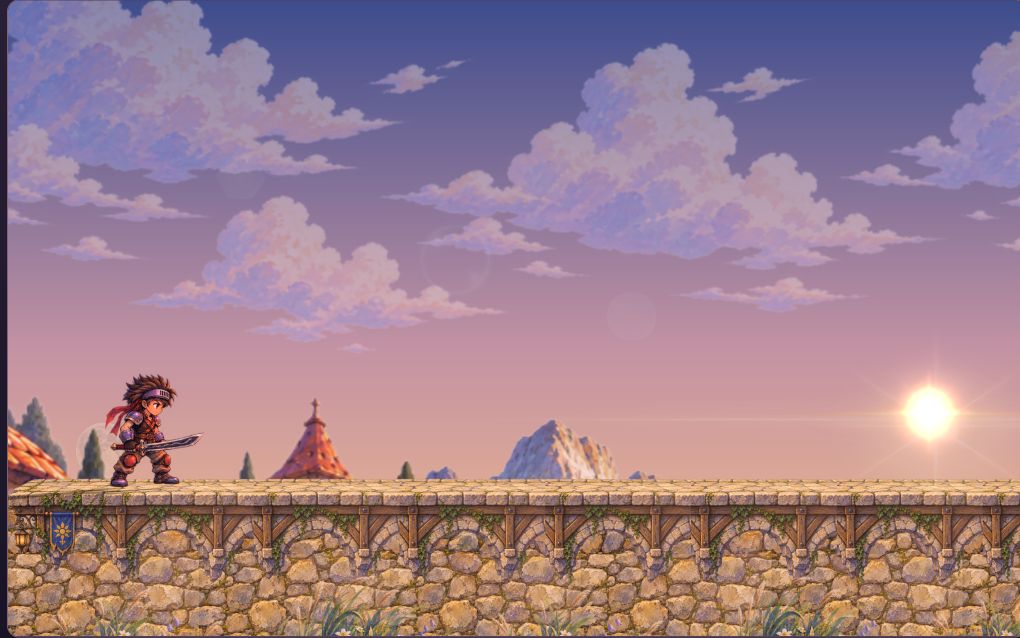
The original Episode 2: The Quest remains preserved. Its new painted remake runs directly in HTML5 and is playable locally; this update shares its progress without claiming that the new build has already been added to the public game pages.
A run that reads as a run.
The new eight-frame run includes the closed-leg passing poses missing from the first sheet. A missing sword was restored, and a separate complete slash replaces the clipped attack drawing. Didga, Gazella and the monsters keep the approved painterly fantasy style.
The character had become soft when the lighting pass reduced the artwork and enlarged it again. Higher-resolution pose buffers and a display-density canvas now preserve more of the painted detail while keeping the character’s scale and feet in place.
Platforms with their own character.
The approved grass, roots, stone, cave and village designs now supply the platform art, with newly painted spikes and fireballs. Their visible surfaces follow the original collision layout, so decorative roots and rock edges do not move the landing points.
Let the sky reach the whole image.
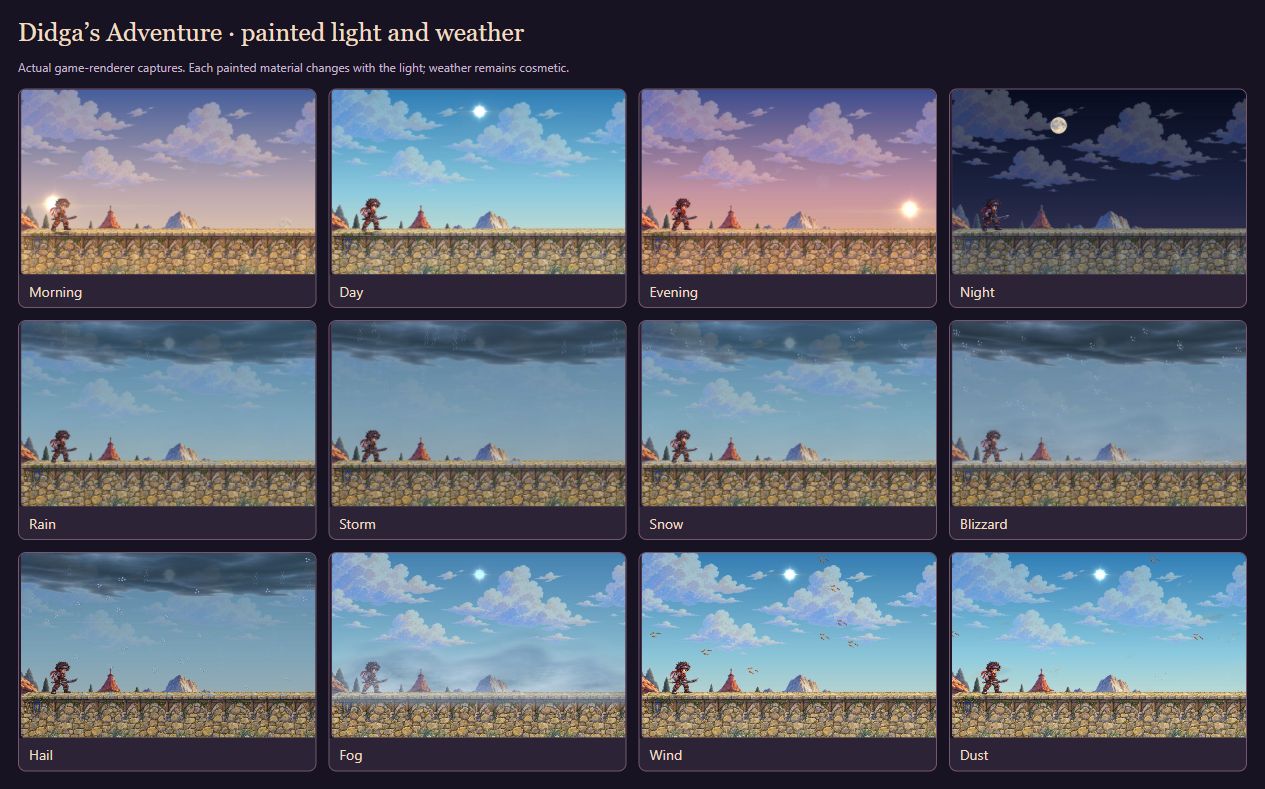
Separate mountain, woodland, village, cave, foreground and cloud layers scroll at different speeds as the camera moves. The open sky leaves room for the Sun and Moon to rise and set. Morning gold, natural daylight, evening amber and rose, and readable blue-violet night colors affect the characters, platforms, hazards and scenery.
The weather cycle includes clear, cloudy, rain, storm, snow, blizzard, sleet, hail, fog, wind and dust. Painted particles, ground contacts, clouds and actor coatings respond to those conditions; storm lightning changes the light without dealing damage. The world clock continues through saved adventures and pauses with play. Sky Studio previews the real renderer without changing a saved game.
More ways to play.
Browser-recognized gamepads can use standard controls or saved custom button and stick mappings. Controller navigation reaches the title, dialogue, pause, retry and ending screens, with keyboard and touch controls available alongside it. A lost controller pauses play safely.
This uses the browser’s Gamepad API. Hardware gameplay and remapping remain unverified; automated checks covered browser input handling.
Four themes, arranged again.
The original town, field, cave and boss themes went into separate Suno Studio projects as references for modern JRPG instrumental remixes. One version was selected for each role: Warm Town Morning, Open Road Adventure, Cavern Whispers and Final Rush.
The selected remixes now supply the town, field, cave and boss music in the local remake. Their generated arrangements reinterpret the source themes. The longer field and boss cues have been kept in full; the town cue has a brief near-silent tail removed. The game copies use consistent playback levels and short endpoint fades. All four exact native exports and the original nineteen audio and sound-effect files remain preserved separately.
What has been checked.
All 69 automated checks passed: 64 game checks and five packaging checks. All four runtime music files fully decoded during validation. Native browser checks covered saved-game continuation, movement, jumping, attacks, crouching, pause and resume, mobile fit, sharper character rendering, the corrected sword pose, all weather previews, the light palettes and the celestial cycle. The final soundtrack check confirmed town playback, sound on/off and pause/resume while retaining saved progress, with no console errors or warnings.
All 23 original files remain unchanged. The full fifty-kill quest and boss route were checked through simulation, rather than a complete final manual playthrough. The weather follows the original collision geometry; its body coatings use the current sprite silhouette and accumulated conditions.